

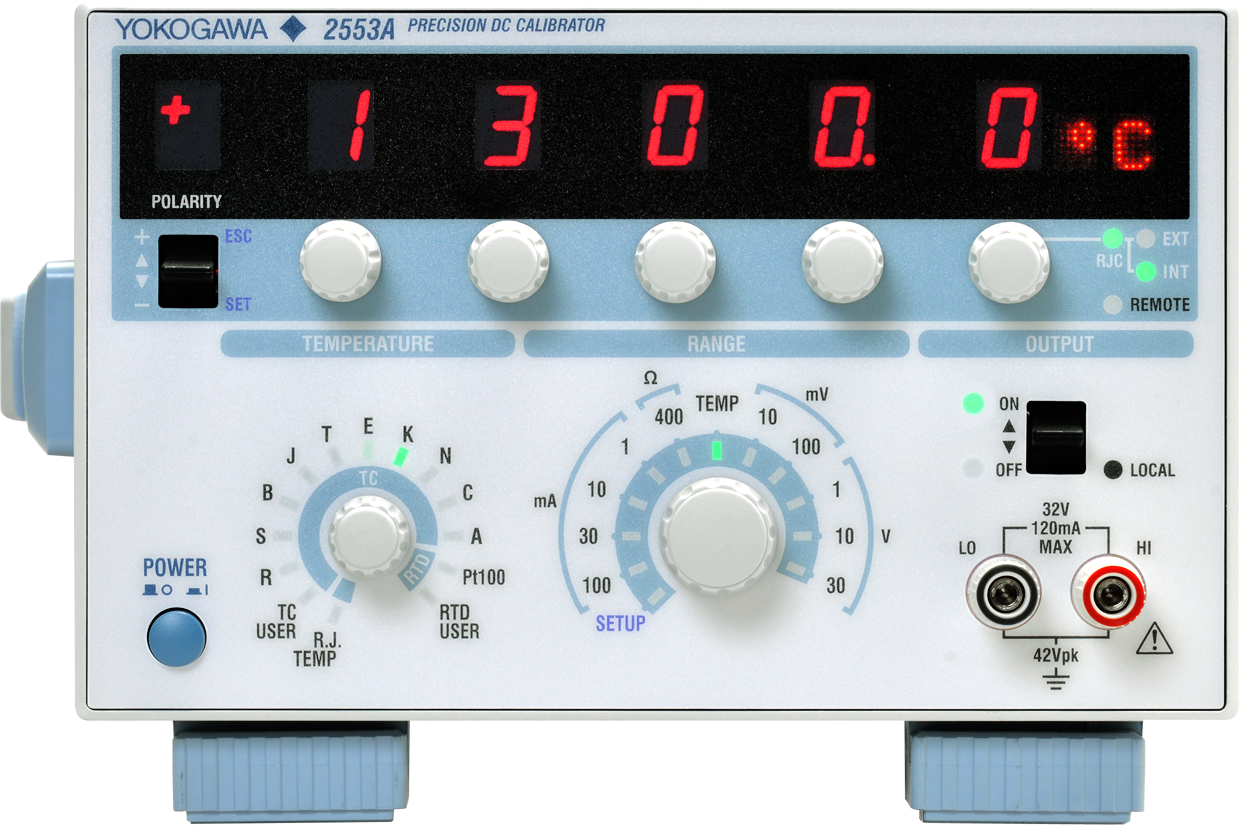
Unmatched Precision Meets Powerful Functionality
The 2553A is designed for calibration of traditional voltage and current measuring devices such as ammeters, voltmeters, digital multimeters and DC wattmeters. It can also calibrate temperature meters and controllers that measure through thermocouples or RTDs, supporting all commonly used thermocouple types regulated by the IEC. Intuitive dials let the user adjust output values quickly, and USB communication and storage allow the 2553A to be used in a larger testbed or as a programmable output device.
Key Features
- Digital display of output on a high-definition seven-segment LED
- High basic accuracy – ±75 ppm DC voltage, ±120 ppm DC current
- High stability and low noise – ±15 ppm/h, 2 µVrms
- High resolution – 5½ digits, ±120,000-count output
- Use as a USB communication or storage device; store setup and text files directly to the unit
- Rich features for calibrating anything from analog standards to precision dataloggers
- Voltage, current and thermoelectric force adjusted with the move of a dial or flick of a switch
- Can sink as well as source with a high degree of accuracy
- Supports 10 IEC thermocouple types (R, S, B, J, T, E, K, N, C, A) with three RJC modes
- Pt100 RTD simulation from −200.0 to 850.0 °C
Specifications
| Voltage ranges | 10 mV (±12.0000 mV, 100 nV) · 100 mV · 1 V · 10 V · 30 V (±32.000 V, 1 mV) |
| Voltage accuracy (1 year) | ±(60 ppm of setting + 4 µV) on 10 mV; basic accuracy ±75 ppm |
| Current ranges | 1 mA (±1.20000 mA, 10 nA) · 10 mA · 30 mA · 100 mA (±120.000 mA, 1 µA) |
| Current accuracy (1 year) | ±(80 ppm of setting + 0.04 µA) on 1 mA; basic accuracy ±120 ppm |
| RTD simulation | Pt100, −200.0 to 850.0 °C, 0.1 °C resolution, ±0.15 °C (1 year) |
| Resistance simulation | 400 Ω range, 18.00 to 400.00 Ω, ±(75 ppm of setting + 0.015 Ω) |
| Thermocouples | 10 IEC types: R, S, B, J, T, E, K, N, C, A |
| Stability | ±15 ppm/h |
| Noise | 2 µVrms |
| Resolution | 5½ digits, ±120,000 counts |
| Max output | Approx. 30 VA |
| Sink capability | Yes, on the 30 mA range (4–20 mA two-wire transmitter simulation) |


Leave a Reply